


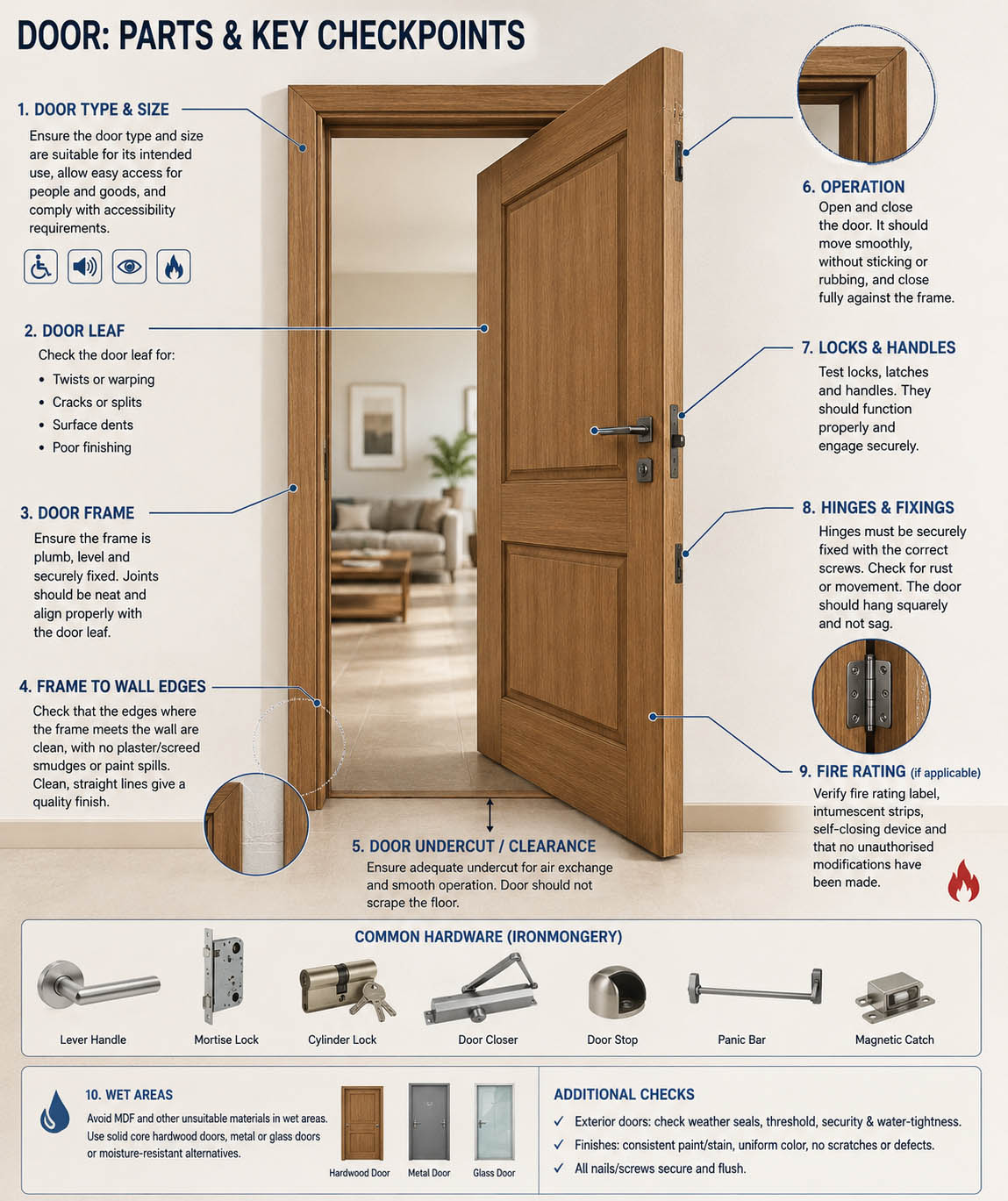
When inspecting a building, doors are often overlooked despite being among the most frequently used components in any structure. Unlike walls, floors, and ceilings that remain largely static, doors are constantly opened, closed, pushed, pulled, and exposed to daily wear and tear. Poorly installed or improperly specified doors can lead to functional issues, security concerns, reduced durability, and costly maintenance.
A thorough door snagging inspection helps identify defects before handover and ensures that doors perform as intended throughout their lifespan. Below are the key areas to examine when snagging doors on any construction project.
1. Verify the Correct Door Type and Size
The first step is to confirm that the installed door is suitable for its intended purpose.
Consider the following:
- Is the door wide enough for the expected traffic flow?
- Does it allow easy movement of furniture, equipment, or goods?
- Does it comply with accessibility requirements for physically challenged users?
- Is a vision panel or glazed section required for visibility and safety?
- Does the space require acoustic (soundproof) doors?
- Are fire-rated doors specified where necessary?
Selecting the wrong door type can create operational problems that are difficult and expensive to correct later.
2. Inspect the Door Leaf
The door leaf is the movable panel that swings or slides.
Check for:
- Twists or warping
- Cracks or splits
- Surface dents and scratches
- Delamination of veneers or laminates
- Uneven edges
- Poor finishing or paint defects
A quality door leaf should be straight, smooth, and free from visible damage.
3. Examine the Door Frame
The door frame provides structural support and determines how well the door operates.
Ensure that:
- The frame is plumb and level
- Joints are neat and well-finished
- The frame aligns properly with the door leaf
- The door closes evenly against the frame
- There are no visible gaps or distortions
A poorly installed frame often causes sticking, rattling, or difficulty in locking the door.
4. Check Frame-to-Wall Finishes
One of the most common finishing defects occurs where the frame meets the wall.
Inspect for:
- Paint smudges
- Excess plaster or screed
- Cracked sealant
- Uneven joints
- Rough edges
Clean, straight lines between the frame and wall are essential for a professional finish. Good workmanship is often evident in these details.
5. Verify Door Clearances and Undercuts
Adequate clearance is necessary for smooth operation and ventilation.
Check that:
- The door does not scrape the floor finish
- The gap between the door and floor is consistent
- The undercut allows sufficient air circulation where required
- Clearances comply with project specifications
Excessive gaps can affect privacy, sound insulation, and energy efficiency, while insufficient gaps can cause operational problems.
6. Test Door Operation
Open and close the door multiple times.
The door should:
- Move smoothly without resistance
- Remain stable without wobbling
- Open to the intended angle
- Close fully without force
- Not self-open or self-close unless designed to do so
Any stiffness, binding, or unusual movement should be investigated.
7. Inspect Locks, Handles, and Ironmongery
Door hardware should function correctly and feel secure.
Test:
- Locks and latches
- Handles and lever sets
- Door closers
- Panic bars (where applicable)
- Door stops
- Magnetic catches
All hardware should operate smoothly and align correctly. Locks should engage fully without requiring excessive force.
8. Examine Hinges and Fixings
Hinges are critical to the long-term performance of a door.
Check that:
- Hinges are securely fixed
- Correct screws have been used
- There are no missing fixings
- Hinges are free from rust or corrosion
- The door hangs squarely
Low-quality or improperly installed hinges often lead to sagging doors over time.
9. Verify Fire-Rated Doors
Where fire doors are specified, additional inspections are necessary.
Confirm:
- The correct fire rating has been installed
- Fire certification labels are present
- Intumescent strips are installed where required
- Self-closing devices function properly
- Glazing complies with fire-rating requirements
- No unauthorised modifications have been made
Fire doors form part of a building’s life-safety system and should never be accepted without proper verification.
10. Assess Doors in Wet Areas
Bathrooms, laundry rooms, kitchens, and other wet areas require special attention.
Avoid materials susceptible to moisture damage, such as:
- Standard MDF doors
- Untreated timber doors
- Low-quality particleboard products
Suitable alternatives include:
- Solid-core hardwood doors
- Moisture-resistant composite doors
- Metal doors
- Glass doors
Signs of moisture damage include swelling, peeling finishes, warping, and deterioration around the bottom edges.
11. Check Weather Protection for External Doors
For external doors, inspect:
- Weather seals
- Threshold details
- Water-tightness
- Draught protection
- Security features
External doors should protect occupants from rain, wind, dust, and unwanted entry.
12. Review Appearance and Finish Quality
Finally, stand back and assess the overall appearance.
Look for:
- Consistent paint or stain finish
- Uniform colour
- Straight alignment with adjacent doors
- Clean hardware installation
- No visible defects under normal lighting conditions
The door should complement the overall quality and aesthetics of the building.
Final Thoughts
Doors are among the hardest-working components in any building. Because they are subjected to constant movement and daily use, even minor installation defects can quickly become major maintenance issues.
A proper door snagging inspection goes beyond simply checking whether a door opens and closes. It involves assessing suitability, durability, safety, functionality, and finish quality. By carefully inspecting each of the areas outlined above, homeowners, contractors, and building inspectors can ensure that doors not only look good but also perform reliably for years to come.
Remember: a well-installed door should operate effortlessly, provide the required level of security and privacy, and remain durable throughout its service life.




0 Comments